
Triple Sum Gain - Leveraging AI to Prioritize People & Technology When Mitigating Risk

Optimizing Cyber Security with AI to Bolster Prevention & Maximize Impact
Disruptive technologies and a volatile ecosystem always create the perfect storm for fractious change. AI transforms how companies build, sell, and deliver technology at an exponential pace. To accelerate innovation, connect products and services, and create experiences that truly set them apart, organizations utilize AI to speed up development, improve operations, and scale existing businesses. Simultaneously, to maintain a competitive advantage in the marketplace, companies must also iteratively reinvent themselves for what's next.
For healthcare IT professionals, moving at an expedited pace creates a whole new set of challenges, from potential privacy breaches and intellectual property loss to data sovereignty issues, unsecured code, and compliance failures.
Key Questions
How can we make the explosive growth and fast-paced convergence of AI-based technologies, geopolitical tensions, regulatory concerns, and an accelerating threat landscape more manageable for global organizations?
To rapidly normalize the adoption and implementation efforts, how can organizations harness the power of AI innovation in an ever-evolving landscape while creating new strategies to approach security practices, data privacy, and governance?
What is the best way to align security strategy and business objectives to build programs to balance protection with the needs of the organization?
Triple Sum Gain for Healthcare Cybersecurity Professionals
Cybersecurity professionals in healthcare IT realize a triple-sum gain by elevating people, technology, and processes simultaneously.
For people, they upskill clinicians and IT staff on secure AI use, foster an AI‑resilient security culture, and design human‑in‑the‑loop workflows, so experts always oversee high‑risk decisions.
For technology, they deploy an AI‑enabled security stack, harden AI models against attacks, and modernize IAM to enforce least privilege and strong identity controls around sensitive clinical systems.
For process, they strengthen governance for AI and data use, implement continuous controls monitoring across EHRs and cloud environments, and apply risk‑based prioritization so limited security resources focus on the highest‑impact threats.
This integrated focus means every security improvement simultaneously protects patient data, sustains clinical operations, and supports compliant innovation in digital health.
When Cyber Criminals Use AI Against Healthcare Organizations
AI makes cyber criminals more effective in healthcare by giving them scale, precision, and realism across common attack paths.
Generative AI tools now write flawless, highly personalized phishing emails that mimic EHR vendors, executives, or internal IT, so more staff are tricked into clicking or sharing credentials.
Attackers use AI to scan hospital networks and cloud systems for vulnerabilities, then rapidly tailor malware and ransomware that can evade legacy defenses and hit the most critical systems first.
They also generate deepfake audio or video to impersonate clinicians or leaders, increasing the success of social engineering and urgent‑access scams.
In parallel, adversaries target healthcare’s own AI systems through data poisoning and model evasion, corrupting clinical decision tools or exposing sensitive patient data in new ways.
AI Security Capability Maturity Model
To help prevent cybercrimes, many healthcare organizations use the AI Security Capability Maturity Model (often called an AI Security Maturity Model). It is a structured framework that helps an organization assess the level of advancement and effectiveness of its AI‑related security practices and plan concrete steps to improve them over time. It defines levels or stages of maturity, usually from ad‑hoc/undefined practices up to fully integrated, automated, and optimized AI security. Each level describes what people, processes, and technical controls should look like to manage risks from AI systems (e.g., model misuse, data leakage, prompt injection, poisoned training data).
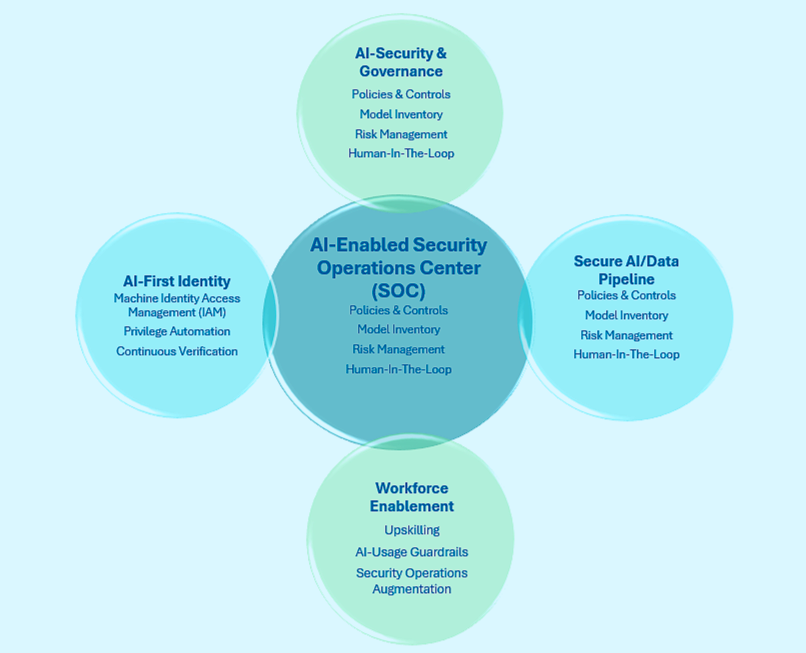
Most AI security maturity models look at capabilities such as:
Governance and policy for AI use (policies, roles, accountability, risk ownership).
Secure AI development lifecycle (threat modeling, secure coding, testing, and validation specific to AI/ML).
Protection of data and models (training data security, access control, monitoring for data or model tampering).
Detection and response for AI‑specific threats (e.g., AI misuse, prompt hacking, adversarial attacks) and how quickly and consistently you respond.
Compliance, auditability, and evidence (can you demonstrate that AI systems are secure and governed appropriately).
Typical Maturity Stages
Very Low Maturity
Informal or invisible AI use, little or no visibility, almost no AI‑specific security controls; security is reactive.
Developing
Basic policies and visibility; some checks in tools like repositories or CI, but gaps and inconsistent enforcement.
Defined/Standardized
Common processes and tooling for AI security across teams, regular monitoring, and clearer governance.
Proactive
Guardrails and controls are embedded “left‑shifted” into IDEs, generation‑time checks, and pre‑commit/pre‑deployment prevention.
Optimized/Operationalized
AI‑native security with multi‑layer defenses, high automation, continuous improvement, strong auditability, and minimal unplanned AI‑related incidents.
AI Best Practices in Healthcare Cyber Security
AI is now shaping both how cyberattacks are carried out and how defenses are built, with generative AI and automation at the center of current trends.
According to Gartner, there are six trends shaping AI best practices in cybersecurity.
1. Agentic AI Demands Cybersecurity Oversight - Cybersecurity leaders must identify both sanctioned and unsanctioned AI agents, enforce robust controls for each, and develop incident response playbooks to address potential risks.
2. Global Regulatory Volatility Drives Cyber Resilience Efforts - Shifting geopolitical landscapes and evolving global mandates have made cybersecurity a critical business risk with direct implications for organizational resilience.
3. Postquantum Computing Moves into Action Plans - Healthcare organizations to identify, manage, and replace traditional encryption methods, while prioritizing cryptographic agility.
4. Identity and Access Management Adapts to AI Agents - new challenges to traditional identity and access management (IAM) strategies pose a threat, especially in identity registration and governance, credential automation, and policy-driven authorization for machine actors.
5. AI-Driven Security Operations Center (SOC) Solutions Destabilize Operational Norms - The emergence of AI-enabled SOCs is introducing new complexity, which is contributing to staffing pressures, increased upskilling demands, and evolving cost considerations for AI tools.
6. GenAI Breaks Traditional Cybersecurity Awareness Tactics - Strengthening governance, embedding secure practices, and establishing policies for authorized use will reduce exposure to privacy breaches and intellectual property loss.
Cyber Criminals Are Evolving: An Offensive Perspective on AI
Attackers are rapidly operationalizing AI to scale and sharpen their campaigns. AI‑driven phishing and social engineering generate highly personalized emails, messages, and voice deepfakes at scale. Deepfake and voice‑cloning fraud is driving high‑value business email compromise and fake executive scams. AI is being used to automate reconnaissance and vulnerability discovery, speeding up the finding of weak points in networks and apps. Emerging autonomous attack chains combine AI for reconnaissance, payload generation, and adaptation to defenses with minimal human control.
Efforts to Secure AI
Since AI systems are high‑value assets that must be secured end‑to‑end, organizations are building governance for model access, data usage, logging, and human oversight of AI‑driven security decisions. There is a growing focus on protecting models and pipelines from data poisoning, prompt/indirect injection, model theft, and abuse of public large language models (LLMs). AI is being used for secure coding assistance, vulnerability triage, and automated controls testing to harden software and infrastructure.
The Evolving Role of AI in Cybersecurity - Pilots to Large-Scale Deployments
According to the Boston Consulting Group, the latest research shows that most enterprises believe they have already seen AI‑enabled attacks, but only a small fraction are mature in AI‑enabled defense, creating a capability gap. Investment in GenAI‑enabled cybersecurity tools and services is expected to grow several‑fold over the next few years as organizations adopt AI across cloud, endpoint, and identity security. Boards and regulators are pushing for explicit AI‑cyber strategies, including risk scoring, third‑party risk, and continuous compliance monitoring with AI support.
What's On Deck for Cybersecurity Programs?
Per Cyber Security Magazine, security programs need to prioritize an AI roadmap.
Here's what healthcare IT professionals need to expect next.
Assume AI‑enabled phishing, fraud, and reconnaissance, and strengthen identity, email security, and user education to reflect that threat level.
Introduce AI in high‑leverage areas first: alert triage, threat correlation, vulnerability prioritization, and secure coding support.
Build an AI security governance framework including policy, model inventory, monitoring, red‑teaming of AI systems, and clear human‑in‑the‑loop controls.