

AI Development & Analytics
Automating existing workflows to improve efficiency and save costs.
Healthcare boards have moved past the question of whether artificial intelligence belongs in their organizations.
What they are asking now is harder and more practical: which applications justify the risk, which produce measurable return inside a budget cycle, and who is accountable when a model contributes to an outcome no one intended.
Most organizations are caught between two unsatisfactory positions. Move too slowly, and the administrative cost burden that AI could address continues to compound. Move without governance, and you accumulate unmanaged models, shadow tools, and regulatory exposure that surfaces at the worst possible moment.
Elevance Solutions builds and operates AI and intelligent automation for hospitals and health plans in the space between those positions. We deploy where the business case is clear and the risk is manageable, with governance established before the first model reaches production rather than assembled after an incident.
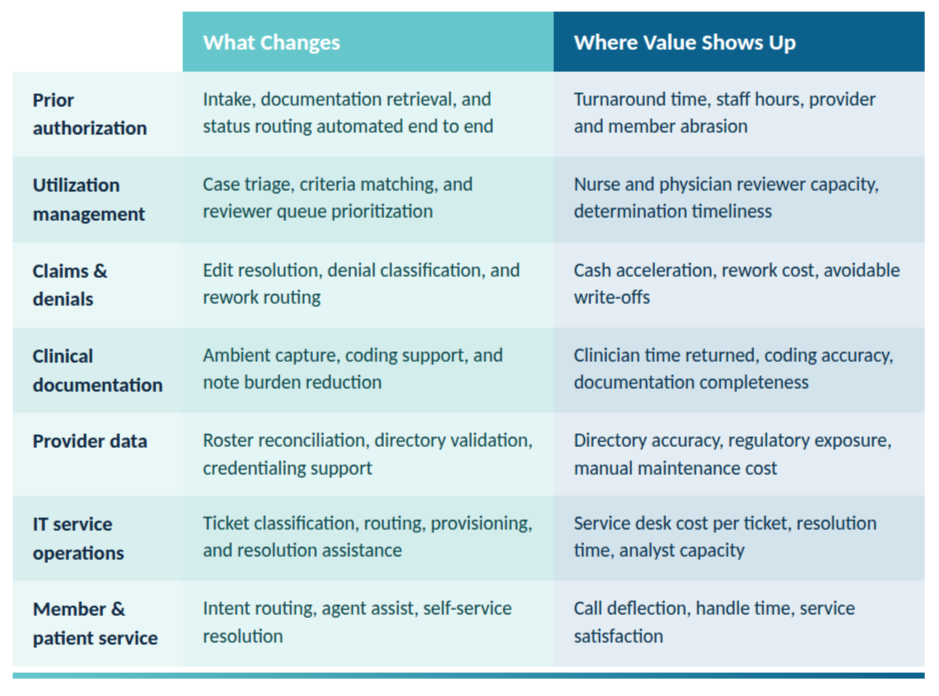
Where the Return is the Clearest

Request an AI Readiness Assessment Today
Governance-first · Human-in-the-loop by design · Documented, monitored, reversible · HIPAA-aligned · SLA-governed
Service Capabilities
AI Strategy & Use Case Prioritization
Deciding what to build before deciding how.
Most disappointing AI programs began with a technology decision rather than an operational one. We start on the other end. We conduct an opportunity assessment grounded in where work is genuinely lost in your organization, size each candidate use case by effort, expected return, and risk exposure, and evaluate build versus buy honestly— including recommending vendor solutions where a capable one already exists. The deliverable is a sequenced portfolio with a business case per use case, an accountable owner identified for each, and clear criteria for what constitutes success and what would justify stopping.
We also assess readiness candidly. Organizations without governed data or documented processes aren't ready to automate, and we will say so rather than build on a foundation that will not hold.

Intelligent Process Automation
Removing the administrative work that consumes capacity.
The largest near-term return in healthcare is rarely in clinical AI. It is in the high-volume, rules-driven administrative work that currently consumes trained professionals.
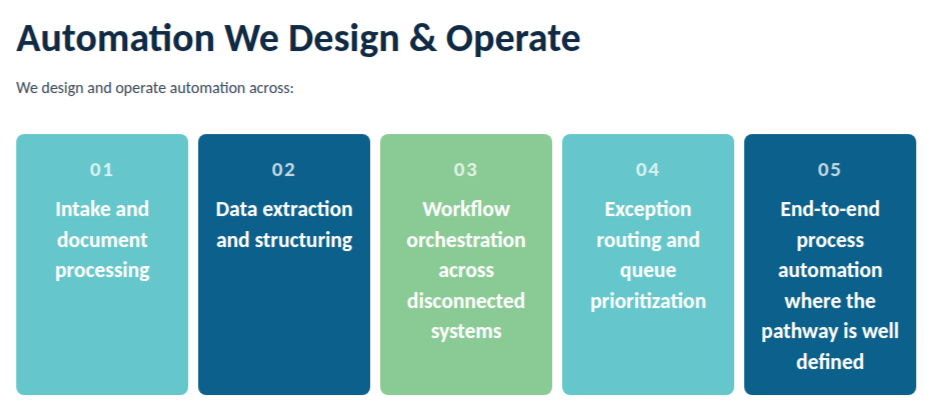
Robotic process automation is used deliberately and where appropriate — as a bridge to systems that offer no interface, not as a permanent architecture. Where an API exists, we build to it.
Applied AI & Model Development
Custom capability where standard tooling falls short.

Where off-the-shelf products do not fit your workflow, data, or regulatory position, we build:
Predictive models — denial likelihood at submission, readmission and deterioration risk, no-show probability, cost trajectory, capacity and volume forecasting
Document and language AI — clinical document classification and extraction, correspondence triage, medical record summarization for review workflows
Decision support — criteria matching, coding and documentation assistance, care gap identification
Conversational and agent-assist — member and patient service, provider inquiry handling, internal service desk
Every model is developed with the operational owner engaged throughout, evaluated against a defined baseline, and deployed only where its output changes a decision someone is accountable for.
Generative AI Enablement
Adoption that is safe, governed, and actually useful.

Generative AI has entered most healthcare organizations, whether or not leadership approved it. The realistic objective is not prevention but governed enablement. We deliver enterprise platform deployment with appropriate PHI controls, retrieval-augmented architecture grounded in your policies, criteria, and documentation, prompt and output governance, use case enablement for clinical documentation, correspondence, summarization, and internal knowledge access, and shadow AI discovery and remediation.
We are direct about limitations. Generative models are unsuitable for certain healthcare tasks, and we will identify those rather than deploy into them.
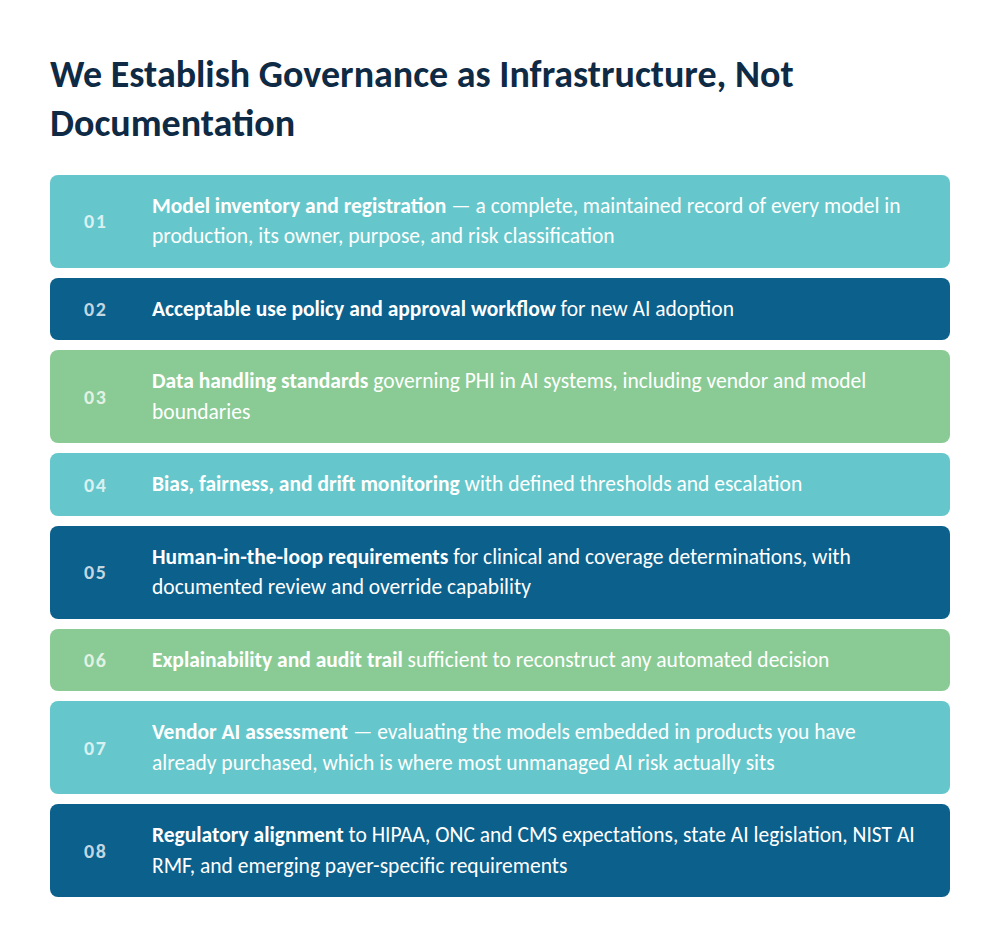
AI Governance & Risk Management
The capability that makes everything else defensible.
-
Clinical AI is deployed with clinician governance participation from the outset, clear scope boundaries, and monitoring that treats model performance degradation as a patient safety concern.
-
Automated influence on coverage determinations now draws direct regulatory and litigation attention. Utilization management automation is designed so criteria application is transparent, clinical judgment remains with licensed reviewers, and every determination pathway is reconstructable.
This is where most healthcare AI programs are weakest and where regulatory attention is increasing fastest.
Deployment, Integration & Operations
Production capability, operated continuously.

A model that works in evaluation and fails in production has returned nothing.
We manage the full lifecycle: integration with EHR, core administrative, and workflow systems; MLOps and deployment pipelines; performance and drift monitoring with alerting; retraining and version management; incident response for model failure; and cost and consumption governance.
Automation and models are operated under the same service levels as the rest of your managed environment — monitored, supported, and accountable.
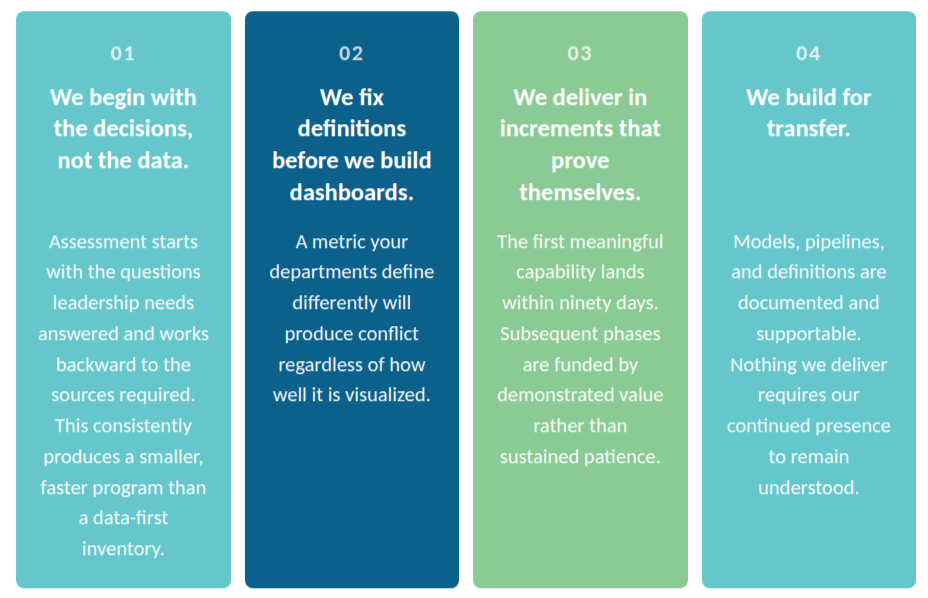
How We Approach Engagement
Why Deliver This As a Managed Service
Data engineers, analytics engineers, and healthcare-experienced data scientists are recruited relentlessly, and healthcare organizations compete for them against technology companies with different compensation structures. Teams are built slowly, lost quickly, and rebuilt at cost.

A managed model provides mature capability from the outset rather than after a two-year hiring cycle, continuity that does not depend on any individual remaining, predictable operating cost in place of variable staffing and contractor spend, and internal capacity redirected from pipeline maintenance to analysis and business partnership.
Performance is measured, reported, and contractually committed.

Get Started with 30-Day Data Assessment.
Within 30 days, your executive team receives an inventory of current data sources, platforms, and reporting assets with cost and ownership documented; identification of where definitions conflict and what those conflicts cost in leadership time and delayed decisions; a prioritized list of analytics opportunities ranked by decision impact relative to effort; and a phased roadmap with the first meaningful capability scheduled inside ninety days.
The assessment stands on its own. You will leave with a defensible plan whether or not you choose to engage us for delivery.
-
Hospital assessments include cost accounting maturity and clinical data completeness.
-
Health plan assessments include quality and risk adjustment data readiness and regulatory reporting exposure.