

Data & Analytics
The problem is rarely the data. It is the disagreement about what it says.
Most healthcare organizations have invested substantially in data. They have warehouses, reporting teams, vendor dashboards, and analysts embedded across departments.
What they frequently lack is a single answer to a straightforward executive question.
Ask what a service line costs, what drove last quarter's denial rate, or how a quality measure is trending, and the response often arrives as three numbers from three sources — each defensible, none reconciled. The meeting becomes an exercise in adjudicating definitions rather than deciding what to do. Leadership loses weeks. The underlying issue never gets addressed because the organization never agreed on its shape.
Elevance Systems builds and operates the analytics capability that ends that pattern. A governed data foundation. Definitions your organization has agreed to and can defend. Reporting that reaches leadership without manual assembly. And predictive models applied where they change a decision, not where they demonstrate sophistication.
What It Means in Practice
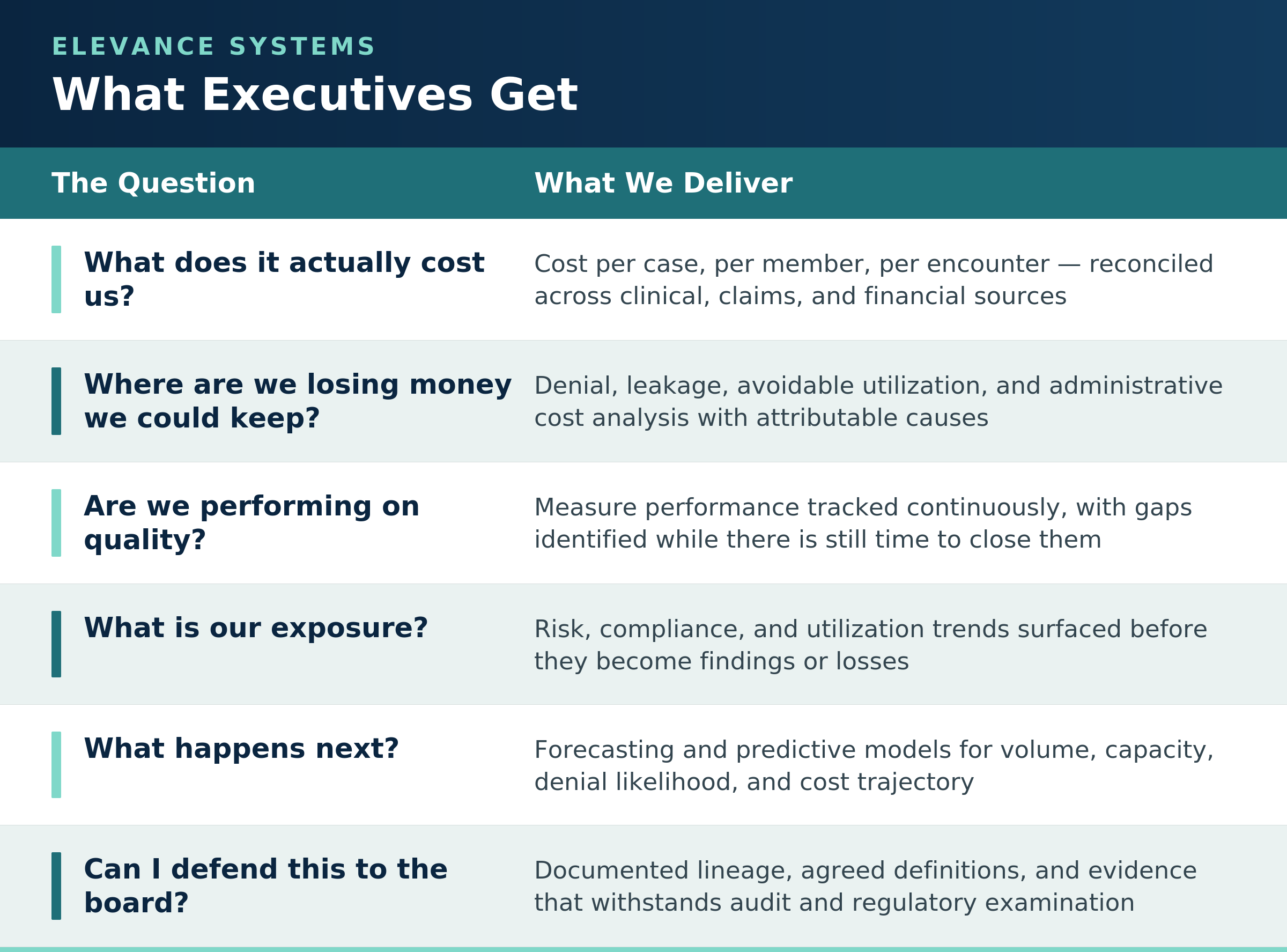

Request a Data & Analytics Assessment
Governed foundation · HIPAA & HITRUST-aligned · Audit-defensible · Managed 24/7 · SLA-governed
Capabilities
Data Foundation & Governance
The part everyone wants to skip and the reason analytics programs fail.
Analytics built on ungoverned data produces faster access to numbers no one trusts — which is worse than no analytics at all, because it consumes credibility along with budget.
We establish and operate the foundation: unified cloud or hybrid data platforms sized to actual workloads; canonical models aligned to healthcare standards including FHIR, HL7v2, X12, and USCDI; identity resolution across patient, member, provider, and facility records; documented lineage so any figure can be traced to its source; and data quality monitoring with defined thresholds and accountable owners.
We also do the unglamorous work that determines whether any of it holds: establishing a metric dictionary, resolving definitional conflicts between departments, and assigning ownership so definitions do not quietly diverge again six months from now.

Executive & Operational Reporting
Insight is only valuable when it triggers action.
Most organizations have more reports than they can use and less insight than they need. We rationalize the reporting estate and rebuild it around decisions rather than requests.
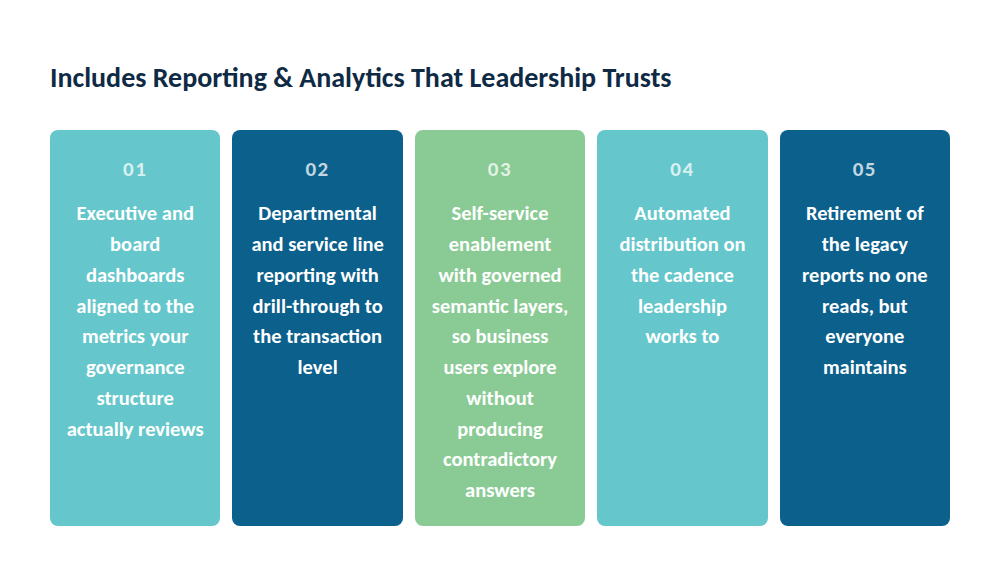
Financial & Operational Analytics
Where margin is found and where it leaks.

Across every line item—from operating room throughput to claims denials to network cost variation—the throughline is the same: margin isn't just measured; it's traced to its source and caught before it erodes, turning financial and operational analytics into a discipline of prevention rather than reconciliation.
-
Cost accounting and service line profitability, throughput and capacity analytics including length of stay and discharge timing, labor productivity and premium pay analysis, supply chain and pharmacy cost variance, and revenue cycle performance from registration through final payment — with denial analytics that identify root cause at the point of origin rather than counting denials after the fact.
-
Medical cost trend and cost-of-care analytics, utilization pattern analysis and outlier identification, network performance and provider cost variation, administrative cost and unit-cost analysis, and payment integrity analytics that surface leakage before it becomes recovery work.
Quality, Regulatory & Risk Analytics
Performance is measured continuously, not discovered at year-end.

Across quality and safety tracking, HEDIS/Stars gap closure, risk adjustment, and clinical variation review alike, the throughline is timing: performance is surfaced continuously and put in front of the physicians and program leaders who can still act on it—so analytics drive the outcome instead of just narrating it after the fact.
The distinction that matters: measurement delivered in time to change the outcome, not to explain it.
-
Quality and safety measure tracking, regulatory and public reporting support, readmission and complication analysis, and clinical variation analytics that make practice differences visible to the physician leaders who can address them.
-
HEDIS and Stars performance with gap identification during the measurement year rather than after it, risk adjustment completeness and accuracy with audit-defensible documentation, care management program effectiveness, and compliance reporting across Medicare Advantage, Medicaid managed care, and Marketplace lines.
Predictive & Advanced Analytics
Applied where a forecast changes a decision.
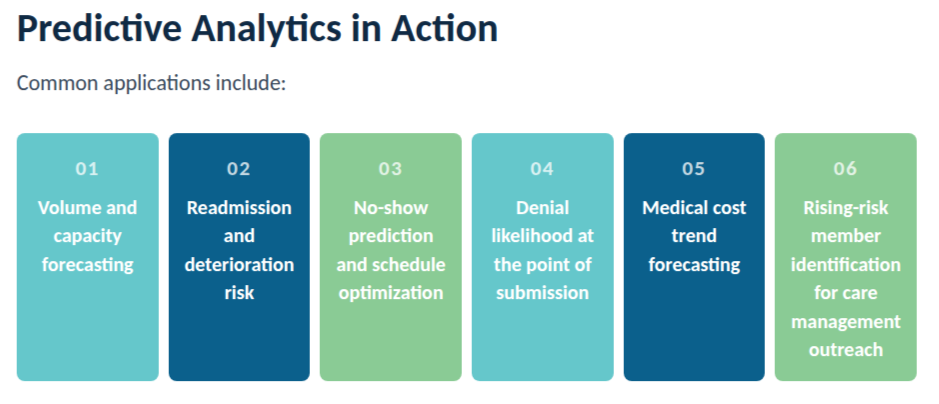
We deploy predictive capability selectively, against use cases with a clear owner and a clear action. Models that no one acts on are a cost without benefit. We document every model, monitor it for drift and performance degradation, and evaluate it for bias—especially when output influences clinical care or coverage decisions. Governance is established before deployment, not retrofitted afterward.
Analytics Operations
Running it, not just building it.

Analytics environments degrade quietly. Pipelines fail without notice, definitions drift, dashboards go stale, and confidence erodes before anyone raises it formally.
We operate the environment continuously: pipeline monitoring with alerting and automated recovery, data quality surveillance against defined thresholds, platform administration and cost management, report and model lifecycle governance, user support and enablement, and change management as source systems evolve. Performance is measured on data freshness, pipeline reliability, and issue resolution time, and reported to your leadership on a defined cadence.
How We Approach Engagement
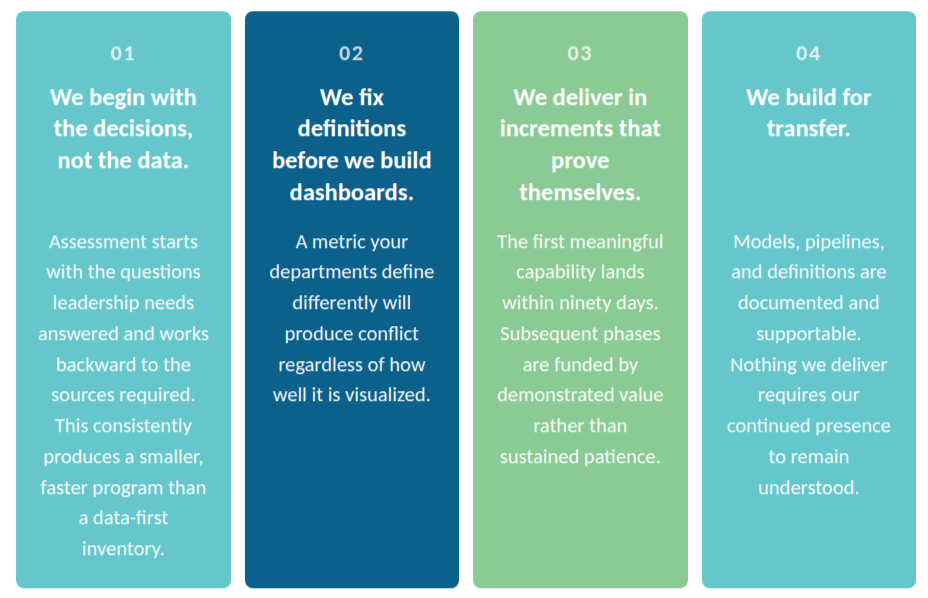
Why Deliver This As a Managed Service
Data engineers, analytics engineers, and healthcare-experienced data scientists are recruited relentlessly, and healthcare organizations compete for them against technology companies with different compensation structures. Teams are built slowly, lost quickly, and rebuilt at cost.

A managed model provides mature capability from the outset rather than after a two-year hiring cycle, continuity that does not depend on any individual remaining, predictable operating cost in place of variable staffing and contractor spend, and internal capacity redirected from pipeline maintenance to analysis and business partnership.
Performance is measured, reported, and contractually committed.

Get Started with 30-Day Data Assessment.
Within 30 days, your executive team receives an inventory of current data sources, platforms, and reporting assets with cost and ownership documented; identification of where definitions conflict and what those conflicts cost in leadership time and delayed decisions; a prioritized list of analytics opportunities ranked by decision impact relative to effort; and a phased roadmap with the first meaningful capability scheduled inside ninety days.
The assessment stands on its own. You will leave with a defensible plan whether or not you choose to engage us for delivery.
-
Hospital assessments include cost accounting maturity and clinical data completeness.
-
Health plan assessments include quality and risk adjustment data readiness and regulatory reporting exposure.