
Digital Transformation
Modernization that actually respects how healthcare works.
Transformation in healthcare rarely fails for lack of ambition. It stalls for reasons that are entirely rational: the systems cannot be taken offline, the workforce is already stretched, regulatory obligations leave little tolerance for disruption, and the risk of a failed program outweighs the promise of the one being proposed.
Elevance Solutions modernizes around your environment rather than through it — connecting the platforms you already own through standard interfaces, removing the manual work that accumulates between systems, and building intelligence on a governed data foundation. No rip-and-replace. No pause in operations.
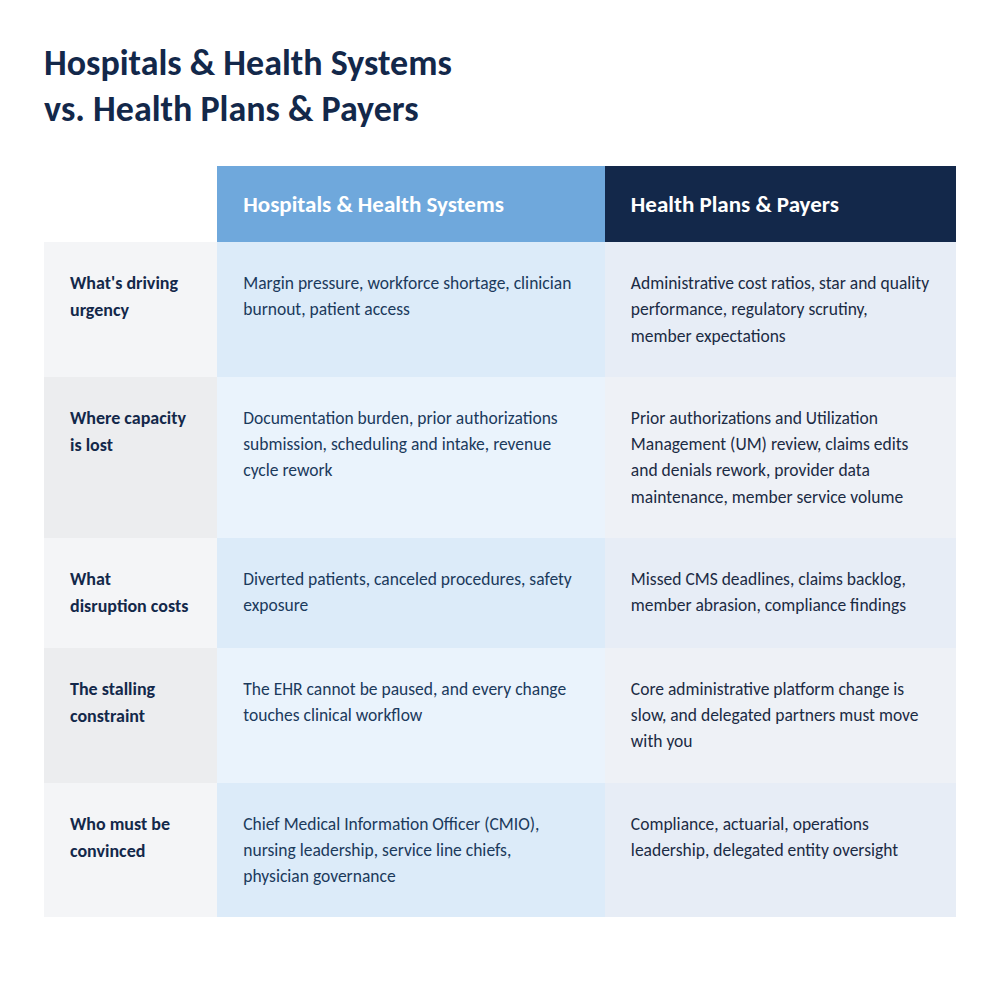
Hospitals and health plans face the same structural obstacles. What differs is where the work is lost, what disruption costs, and who has to be convinced. We deliver accordingly.
Two Organizations, Two Transformations Agendas

Take the Transformation Readiness Assessment Today
Phased delivery · Measurable in the first quarter ·
HIPAA-aligned · Vendor-neutral.
How We Approach Transformation
We start with what stops you, not what impresses you.
Every organization has a list of aspirational initiatives and a shorter list of constraints preventing them. We begin with the second list — the handoffs, the rekeying, the reconciliation, the reports assembled by hand.
We sequence by risk, not by ambition.
Roadmaps typically sequence by architectural elegance. We sequence by clinical and financial risk and by what can be delivered without a downtime event. The systems that matter most are frequently the ones that must be touched last.
We deliver in increments that prove themselves.
Programs showing nothing for eighteen months lose their sponsors. The first measurable operational result lands within ninety days, and subsequent phases are funded by demonstrated outcomes rather than sustained optimism.
What We Deliver
Strategy & Roadmap
A plan your board can act on and your operations team can absorb.
We assess current state across applications, data, integration, and infrastructure; define target-state architecture grounded in your actual constraints; and build a phased roadmap with sequencing, dependencies, effort, and expected return made explicit — including a quantified business case modeled on your volumes.
For hospitals, roadmaps are governed jointly with clinical leadership and sequenced around service line priorities, capital cycles, and survey readiness.
For health plans, roadmaps are sequenced around benefit years, open enrollment, CMS submission calendars, and delegated entity dependencies.
Where prior programs have stalled, we examine why before proposing what comes next.

Data Modernization
The foundation everything else depends on.
Transformation without governed data produces faster access to information no one trusts. We establish unified data platforms, canonical models aligned to healthcare standards, documented lineage and quality thresholds, and identity resolution across patient, member, provider, and facility records — with HIPAA and HITRUST-aligned controls from the outset.

For hospitals and health systems, the priority is a single reliable view across clinical, financial, and operational data — cost per case, throughput, length of stay, and quality measures reconciled rather than contested.
For health plans, the priority is trusted data across lines of business — claims, enrollment, clinical, and provider data unified for risk adjustment, quality reporting, and cost-of-care analytics that withstand regulatory examination.
Interoperability & Integration
Connecting what you own instead of replacing it.
Vendor release cycles do not pause for your operational calendar. We manage the discipline required to stay current: impact analysis, regression testing, training and communication, and cutover planning built around clinical and business rhythms rather than convenience.

For hospitals, this means ADT, order, and result events flowing in real time across the EHR, ancillary systems, and care coordination tools — and payer connectivity that shortens authorization turnaround rather than extending it.
For health plans, it means real-time eligibility, claims status, and authorization exchange with providers and delegated partners, alongside the data flows that CMS interoperability requirements now mandate.
Intelligent Automation & AI
Removing administrative work, deliberately and with boundaries.
Elevance Systems automates the high-volume processes that consume capacity, applying AI with clear limits: models assist and prioritize, people decide. Every automated path is documented, monitored for drift, and reversible.

For hospitals, this concentrates on documentation support, scheduling and intake, prior authorization submission and status tracking, coding and charge capture support, denial rework routing, and IT service operations. Clinical judgment remains with clinicians.
For health plans, it concentrates on prior authorization intake, utilization management triage and review prioritization, claims edit resolution, provider roster reconciliation, appeals and grievance routing, and member service deflection. Coverage determinations remain with the professionals accountable for them.
Governance — model inventory, bias monitoring, human-in-the-loop requirements, and regulatory documentation — is established before deployment, not after.
For payers in particular, this matters: automated influence on coverage decisions now draws direct regulatory attention.
Cloud & Infrastructure Modernization
Platform change without operational disruption.
Cloud migration and re-platforming, hybrid architecture for workloads that cannot leave the data center, resilience and disaster recovery engineering, cost and consumption governance, and infrastructure automation that makes environments reproducible rather than hand-built.
For hospitals, design centers on availability and downtime tolerance — clinical systems that must survive infrastructure failure without interrupting care.
For health plans, design centers on elasticity and throughput — enrollment surges, claims processing peaks, and analytics workloads that scale without permanent overprovisioning.

Digital Experience
Modernizing the interactions people actually have with you.
Sound governance is what separates a portfolio that is administered from one that is merely maintained. The outcome is straightforward: leadership knows what it owns, what each system costs, who is accountable for it, and what should happen to it next.
For provider organizations, this means patient access, scheduling, intake, portal, and communication workflows.
For health plans, it means member self-service, provider portals, digital enrollment, and contact center modernization including IVR and agent-assist.
In both cases, the objective is fewer calls, fewer abandoned interactions, and less staff time spent on transactions that should complete without human involvement.

A case for a managed program
Application talent is scarce, expensive, and difficult to retain — certified analysts are recruited constantly, and a single departure can leave a critical system without coverage. Building depth across every platform in your portfolio, at every support tier, across every shift, is not realistic for most organizations.
A managed model provides:
Depth without headcount — certified expertise across platforms, available when needed rather than carried permanently
Continuity — coverage that does not depend on any individual staying
Predictable cost — operating expense with defined service levels in place of variable staffing and contractor spend
Capacity for your team — internal staff redirected from ticket queues to optimization, governance, and strategy
Accountability — performance measured, reported, and contractually committed