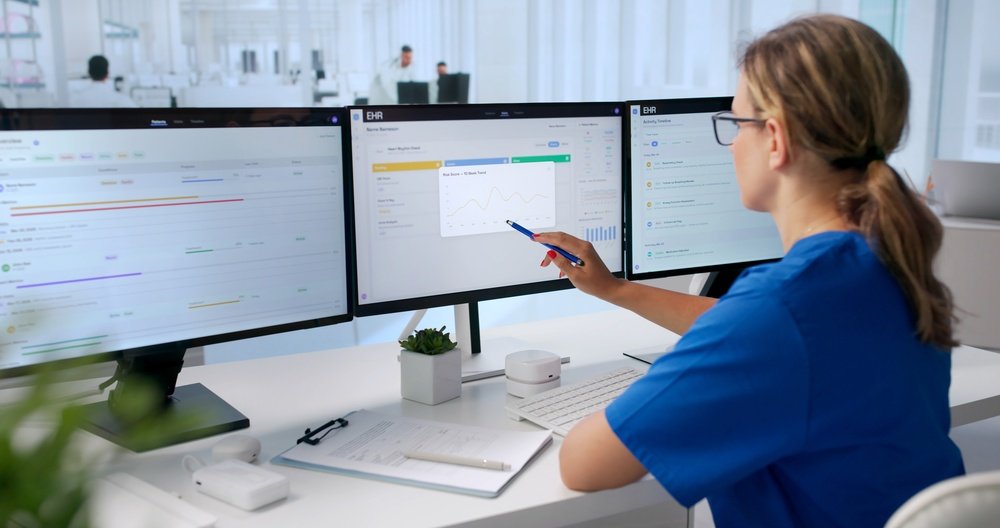
Electronic Health Records & Clinical Data Services
The clinical record is the center of gravity for both sides of healthcare.
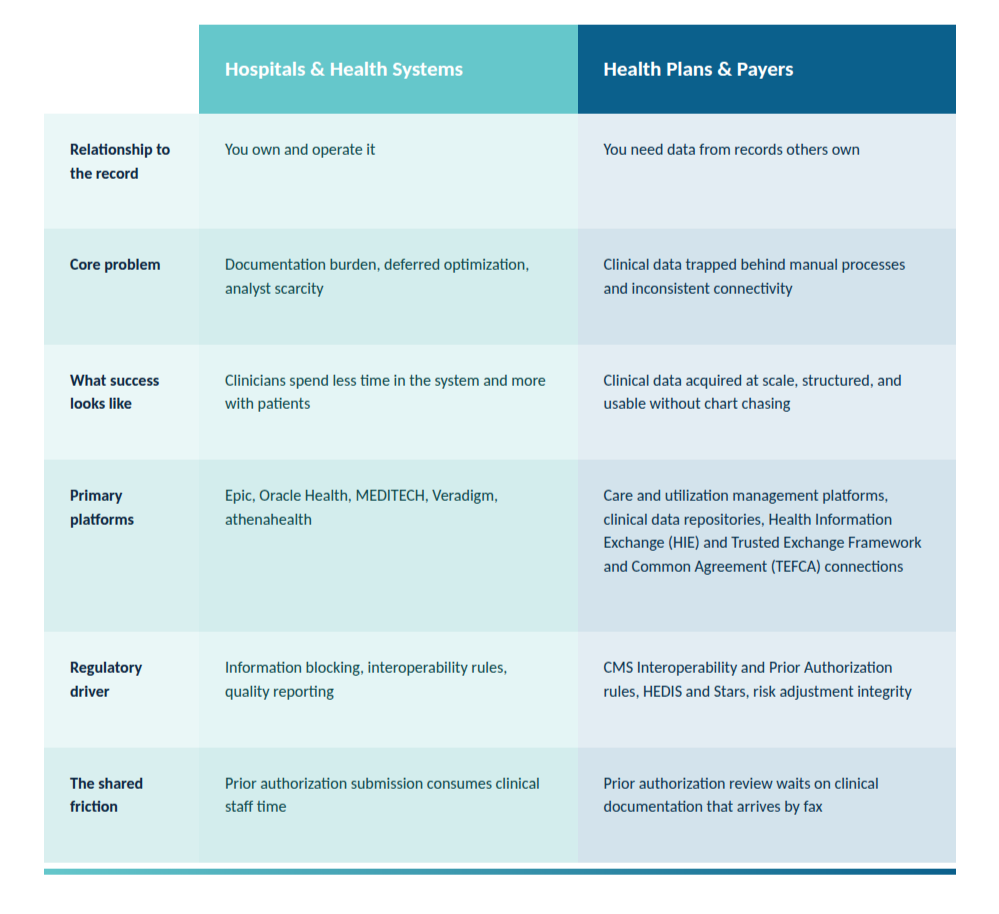
For hospitals and health systems, the EHR is where every clinical and financial workflow converges, and the largest technology investment the organization has ever made. For health plans, the same record is the source of the clinical truth their business increasingly depends on — for utilization review, quality measurement, risk adjustment, and care management — yet it sits inside systems they do not own and cannot control.
These are different problems with a shared root. Hospitals struggle to realize value from a record their clinicians experience as a burden. Health plans struggle to obtain clinical data through channels built for a different era: faxed medical records, portal logins, and manual abstraction.
Elevance Solutions works on both sides of that divide. We optimize and support the EHR for provider organizations, and we build the clinical data acquisition and integration capability health plans need. Understanding both is what allows us to fix the exchange between them.
Two Mandates, One Clinical Record

Request an Assessment Today
Certified analysts · 24/7 support · FHIR & HL7 integration · Vendor-neutral · SLA-governed.
For Hospitals & Health Systems
The pattern is consistent across organizations. Implementations are completed under schedule pressure, with optimization deferred to a phase that never receives funding. Documentation requirements accumulate faster than workflow is redesigned to absorb them. Alerts are added and rarely retired. Certified analysts spend their days closing tickets rather than improving the system.
Our orientation is value realization rather than installation. The platform is in place; our work is making it serve the people who use it.
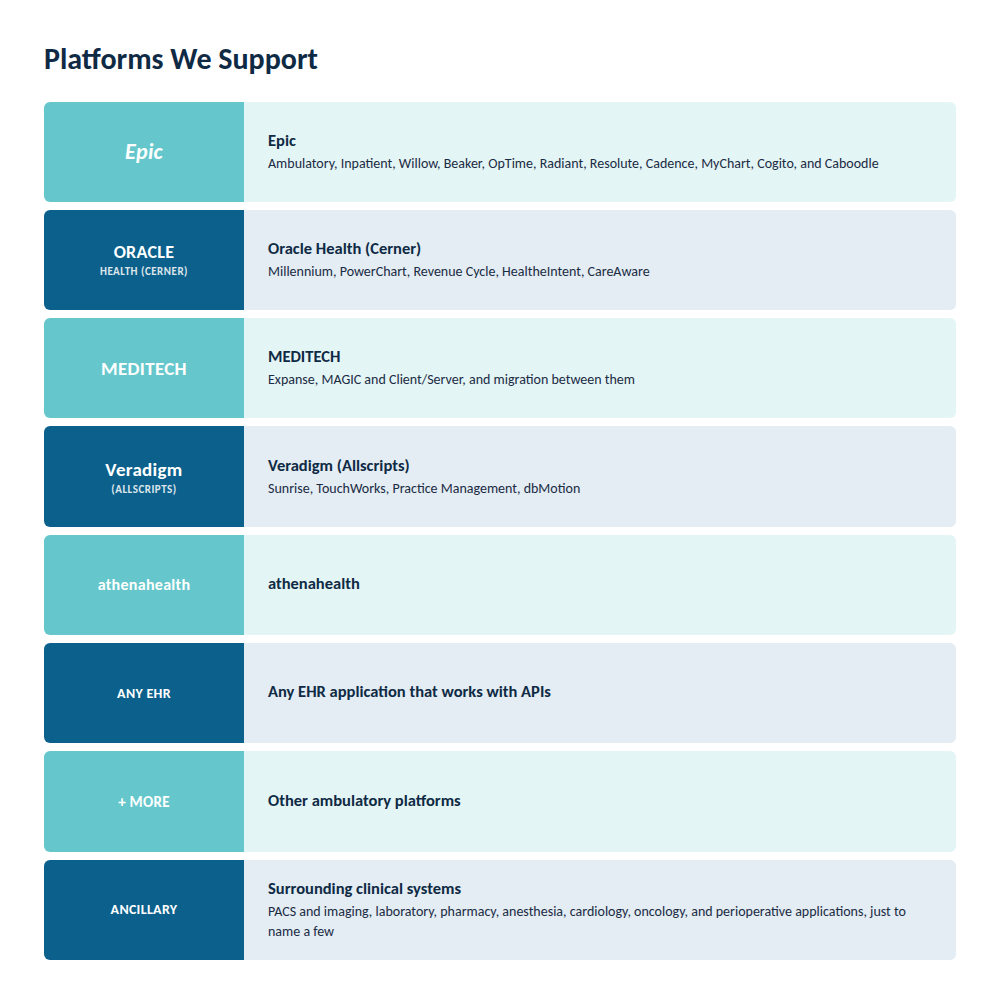
Elevance Systems Supports Your EHR Lifecycle
-
Program and project management, build and configuration, workflow design conducted with clinical and operational owners, testing and validation, data conversion and historical migration, training development and delivery, and command center support through go-live and stabilization.
Affiliation and acquisition work receives particular attention. Bringing a newly acquired hospital or physician group onto the enterprise instance means reconciling workflows, master files, and clinical culture — not simply extending a license.
-
Reducing documentation burden. Note template redesign, smart tool development, ambient documentation enablement, and elimination of duplicative requirements that accumulated without anyone deciding they should exist. Measured in time-in-notes and after-hours charting, not tickets closed.
Improving order and decision support design. Order set consolidation, clinical content governance, alert firing analysis and rationalization, and decision support tuned against actual override rates rather than vendor defaults.
Streamlining revenue cycle workflow. Registration and scheduling redesign, charge capture and coding workflow, denial reduction at the source, and financial clearance and authorization workflow improvement.
Raising adoption and proficiency. Personalization and efficiency coaching, physician and nurse efficiency programs, provider-level usage analysis, and targeted intervention for the clinicians struggling most.
Restoring clinical content governance. Ownership, review cadence, and change control for order sets, templates, alerts, and protocols — so content does not drift back toward the state you just corrected.
-
Tiered support under defined service levels: Level 1 through Level 3 with documented escalation, 24/7 coverage where downtime affects care, break/fix and configuration management, backlog reduction, and on-call rotation that does not exhaust your internal analysts.
Certified coverage is available by application, by module, or across the enterprise — scaled to demand rather than carried permanently. When a key analyst departs, or a module is left without qualified support, we cover the gap and document what we learn so the knowledge stays with you.
-
Version and quarterly release planning, impact analysis, regression and integration testing, environment management, change control aligned to your clinical governance structure, end-user readiness, and cutover planning built around surgical schedules and census rather than administrative convenience. We remain engaged through post-release stabilization, when issues surface and internal teams are most often left alone.
-
Business continuity access design and testing, downtime procedure development with clinical leadership, staff readiness exercises, recovery sequencing by clinical service — emergency department, operating room, and pharmacy first — and post-downtime data reconciliation. Coordinated with our infrastructure and security practices so technical recovery and clinical continuity operate under one command structure.
-
Current-state assessment and readiness evaluation, data conversion and historical record strategy, legacy archival and decommissioning, dual-maintenance management during transition, and post-migration optimization. For organizations consolidating instances after merger, we address the harder problem underneath: reconciling clinical content and workflow standards across organizations that each believe their approach is correct.
For Health Plans & Payers
Application Modernization
Extending your investment rather than replacing it.
Modernization does not require a rip-and-replace program. In most environments, the faster and lower-risk path is to expose what you already own through modern interfaces and migrate on a schedule your operations and budget can absorb.
Application portfolio assessment and rationalization
Cloud migration and re-platforming
API enablement of legacy systems
Technical debt reduction and code remediation
Phased modernization roadmaps sequenced by clinical and financial risk
Sunset planning for applications at end of vendor support

Application Governance
Discipline that prevents the portfolio from managing you.
Sound governance is what separates a portfolio that is administered from one that is merely maintained. The outcome is straightforward: leadership knows what it owns, what each system costs, who is accountable for it, and what should happen to it next.
Application inventory, ownership, and lifecycle tracking
Demand intake, prioritization, and capacity planning
Vendor and license management
Documentation standards and configuration control
Security and compliance alignment coordinated with your risk program
Performance monitoring and cost transparency

What We Deliver
A case for a managed program
Application talent is scarce, expensive, and difficult to retain — certified analysts are recruited constantly, and a single departure can leave a critical system without coverage. Building depth across every platform in your portfolio, at every support tier, across every shift, is not realistic for most organizations.
A managed model provides:
Depth without headcount — certified expertise across platforms, available when needed rather than carried permanently
Continuity — coverage that does not depend on any individual staying
Predictable cost — operating expense with defined service levels in place of variable staffing and contractor spend
Capacity for your team — internal staff redirected from ticket queues to optimization, governance, and strategy
Accountability — performance measured, reported, and contractually committed