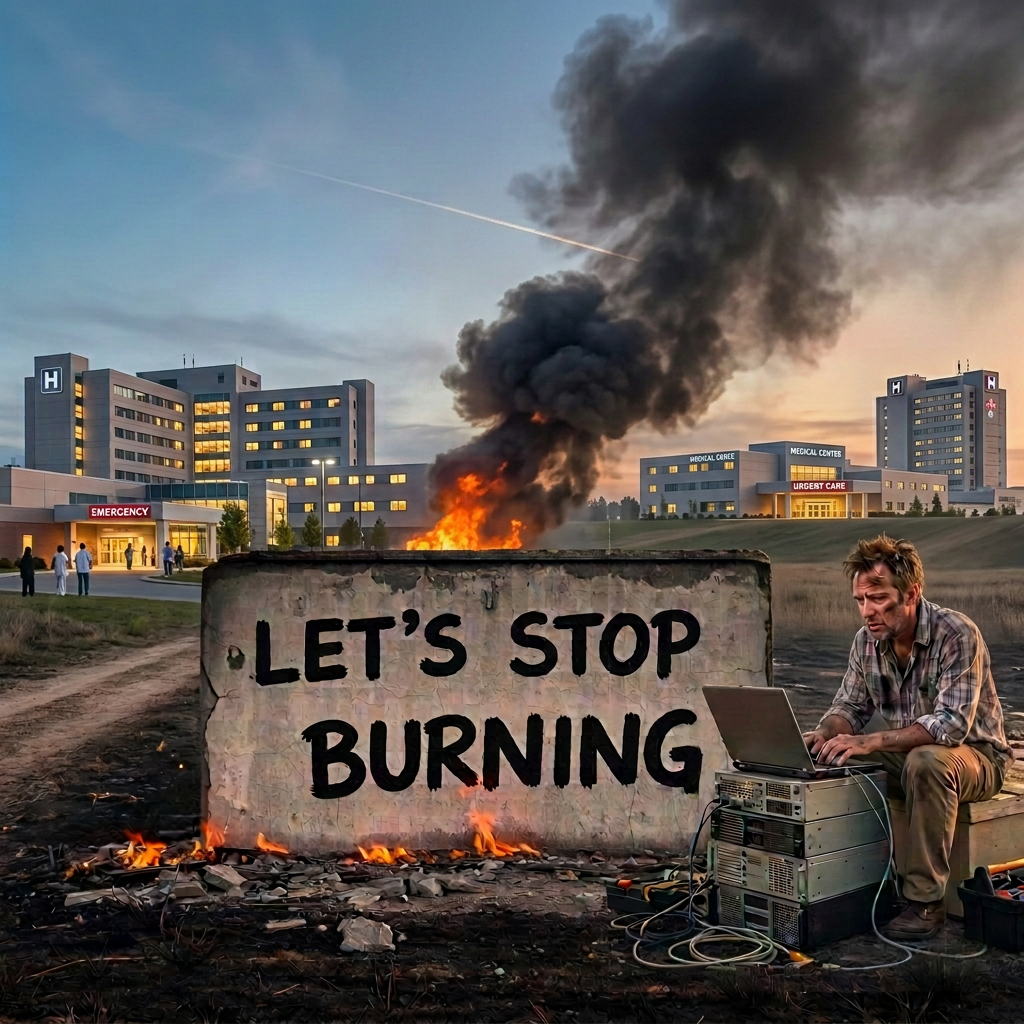
Healthcare IT's "Firefighting" Problem Isn't About Burnout — It's About Math
For years, the go-to explanation for why hospital IT teams feel perpetually behind has been burnout: too few people, too many tickets, not enough sleep. It's a comfortable narrative because it points to a familiar fix — hire more, staff up, take breaks. But the real story is less about who's exhausted and more about what's actually being asked of these teams in the first place.
The Data Behind the Fire Alarm
Roughly two-thirds of healthcare IT teams describe themselves as strained or stuck in constant "firefighting" mode. Only a small fraction — under one in five — say they're comfortably managing operations.
Here's the twist: fully staffed teams report the same level of strain as understaffed ones. If the head count isn't the differentiator, something else is driving the pressure. That something is complexity — the sheer number of systems, integrations, and moving parts that modern healthcare IT now has to keep running at once.
It's Not the Fires. It's the Renovation That Never Ends
The more precise diagnosis than "burnout" is a pace-of-demand problem. IT now touches clinical care, research, cybersecurity, AI adoption, and day-to-day operations simultaneously, and demand is outrunning capacity across all of it.
The word "firefighting" itself is arguably misleading — it implies chaos and surprise, when in reality much of the strain comes from planned work that simply never lets up. Vendor releases. Security patches. New integrations. There's no season when the building isn't under construction.
That distinction matters. A fire eventually goes out. Continuous construction doesn't — it just becomes the baseline condition of the job.
Three Forces Compounding the Pressure
1. Vendors are shipping faster, and security expectations have tightened. Major product updates that once arrived every 12 to 18 months now show up quarterly, each one carrying more code and less time to test it. At the same time, the acceptable patch window has shrunk from "within 30 days" to "urgently." More surface area, less runway — that's a structural shift, not a temporary spike.
2. Cybersecurity has moved from a project to a permanent condition. It's no longer something IT budgets for periodically; it's continuous, and third-party incidents can pull a team into a crisis it didn't create.
3. AI is adding a new layer of demand — and new discipline requirements. Everyone wants the new tools. But without a clear problem statement and a measurable outcome attached to each AI initiative, organizations risk pouring hours into solutions that don't actually move the needle. And a technology's real cost doesn't end at procurement — most new capabilities generate net-new operational work in year one. If that workload isn't accounted for at approval time, IT absorbs it quietly.
The Warning Signs Show Up Before the Resignation Letter
Burnout in an IT organization rarely looks dramatic. It looks like documentation that quietly stops getting updated. Small process improvements that stop happening because everyone's heads-down on tickets. Your best people declining projects they used to raise their hand for.
By the time turnover hits, an organization has often already lost the institutional knowledge that's hardest to replace. A more reliable early signal is watching the ratio of planned to unplanned work, how seriously change requests get reviewed, and whether the same one or two engineers keep showing up in every after-hours escalation. If one person is the answer to three different problems, that's not depth — that's a single point of failure with a pulse.
The Invisibility Problem
Good IT work is invisible by design. When a bridge holds under traffic, nothing appears to happen. When a vulnerability gets remediated before it's exploited, no one sees the outage that didn't occur.
That creates a perverse incentive at budget time: the team that prevented a crisis can look less essential than the team that responded to one, even though the math runs backwards. It's on IT leadership to make that invisible work legible — to tell the story of what didn't happen, not just what did.
There's a similar gap in how "simple" requests get estimated. A project an operational leader expects to take 10-15 hours can easily balloon to 80 once integrations, workflow changes, training, and change management are factored in. The mismatch isn't laziness or inefficiency — it's a genuine misunderstanding of what deploying anything into a live clinical environment actually requires.
What Actually Helps
The path forward isn't simply "hire more people," though staffing matters. It's structural discipline:
Require an operational owner outside of IT before any new capability gets a go-live date. This forces accountability for the workload a new tool creates, not just its purchase price.
Treat application rationalization as workload management, not spring cleaning. Retiring old systems as new ones come online keeps the total surface area from growing unchecked.
Tie every technology investment to a measurable strategic outcome before greenlighting it. The organizations managing this best aren't the ones saying no to AI and innovation — they're the ones insisting that innovation create capacity rather than compete for it.
The Bottom Line
Calling this "burnout" puts the responsibility on individual resilience. Calling it what it actually is — a structural mismatch between the pace of technological change and the capacity built to absorb it — puts the responsibility where it belongs: on prioritization, governance, and how organizations account for the true cost of the tools they adopt.
Healthcare IT isn't short on effort. It's short on a system that keeps the demand and the capacity in the same order of magnitude.