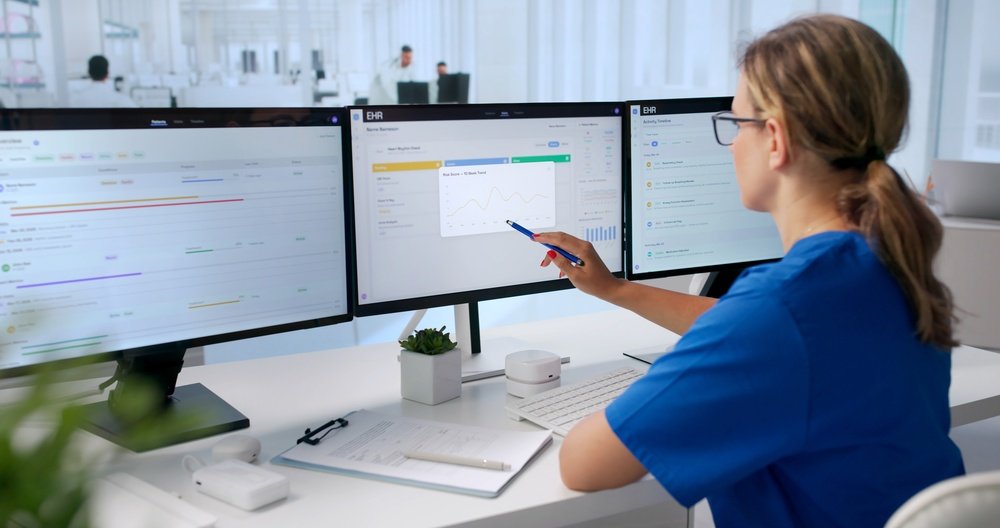
Electronic Health Records & Clinical Data Services
The clinical record is the center of gravity for both sides of healthcare.
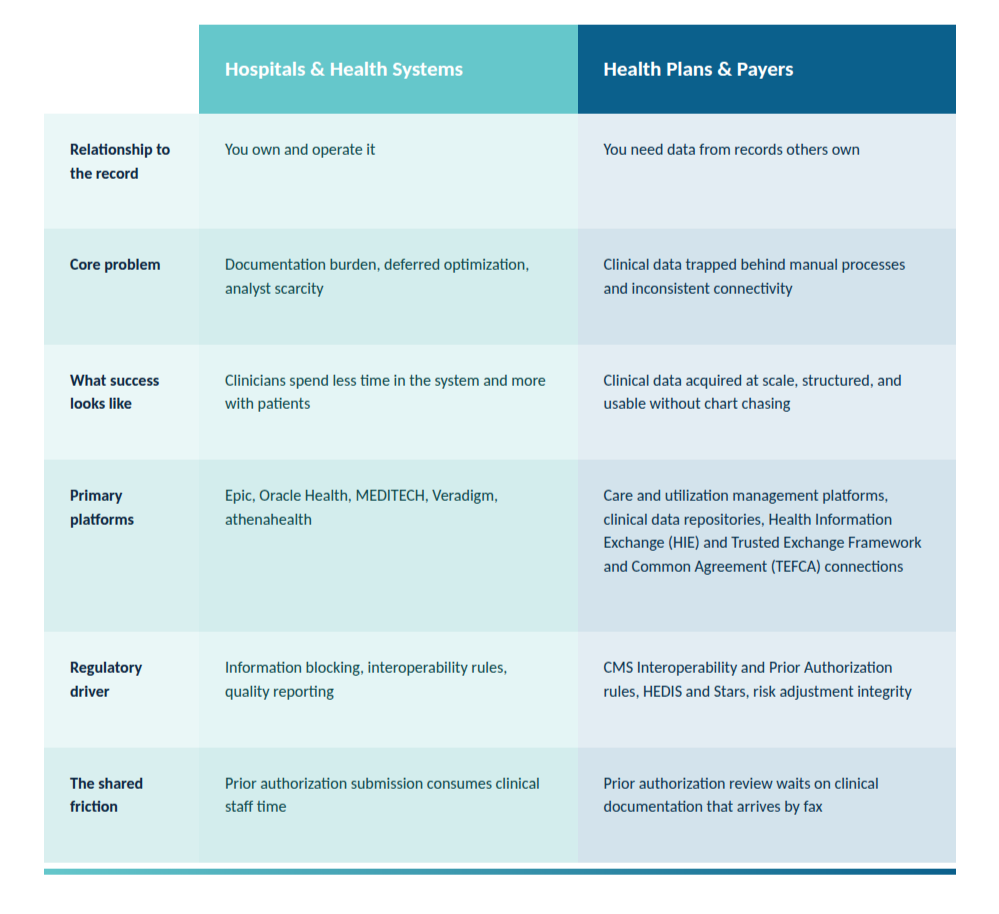
For hospitals and health systems, the EHR is where every clinical and financial workflow converges, and the largest technology investment the organization has ever made. For health plans, the same record is the source of the clinical truth their business increasingly depends on — for utilization review, quality measurement, risk adjustment, and care management — yet it sits inside systems they do not own and cannot control.
These are different problems with a shared root. Hospitals struggle to realize value from a record their clinicians experience as a burden. Health plans struggle to obtain clinical data through channels built for a different era: faxed medical records, portal logins, and manual abstraction.
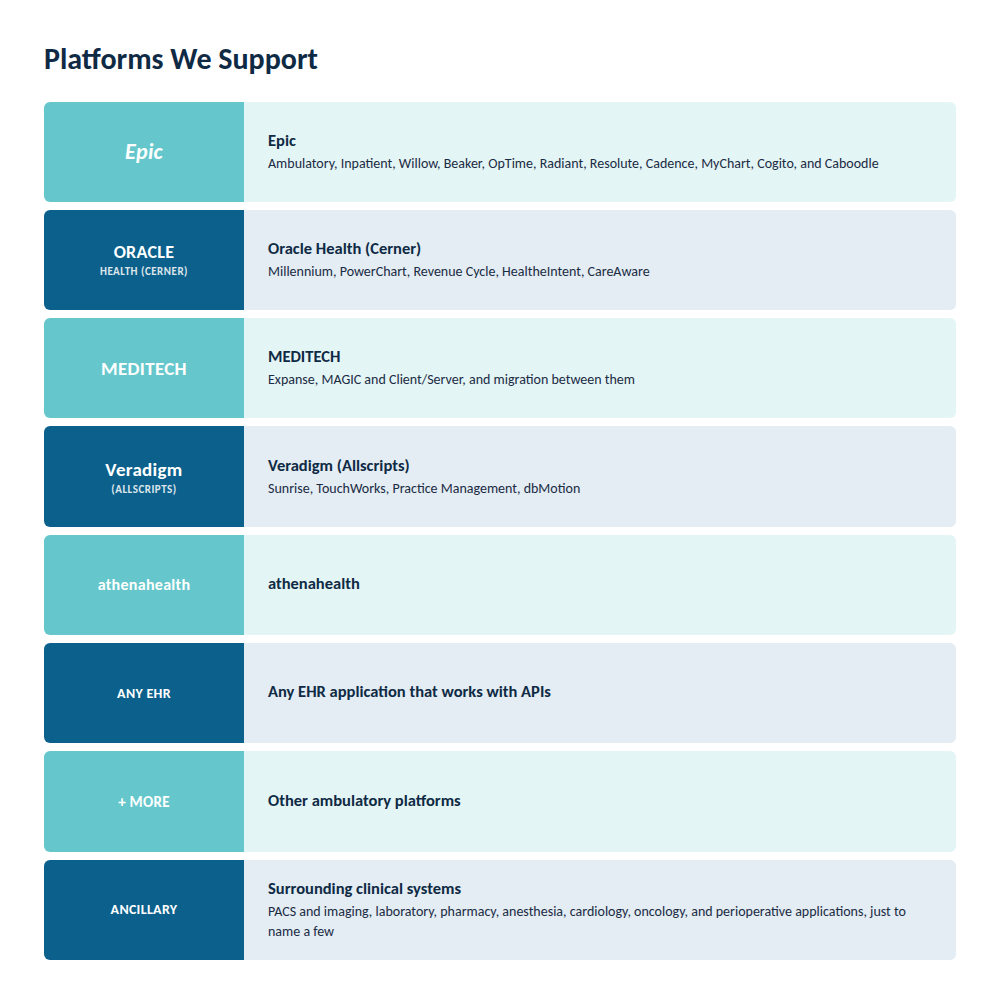
Elevance Solutions works on both sides of that divide. We optimize and support the EHR for provider organizations, and we build the clinical data acquisition and integration capability health plans need. Understanding both is what allows us to fix the exchange between them.
Two Mandates, One Clinical Record

Request an Assessment Today
Certified analysts · 24/7 support · FHIR & HL7 integration · Vendor-neutral · SLA-governed.
For Hospitals & Health Systems
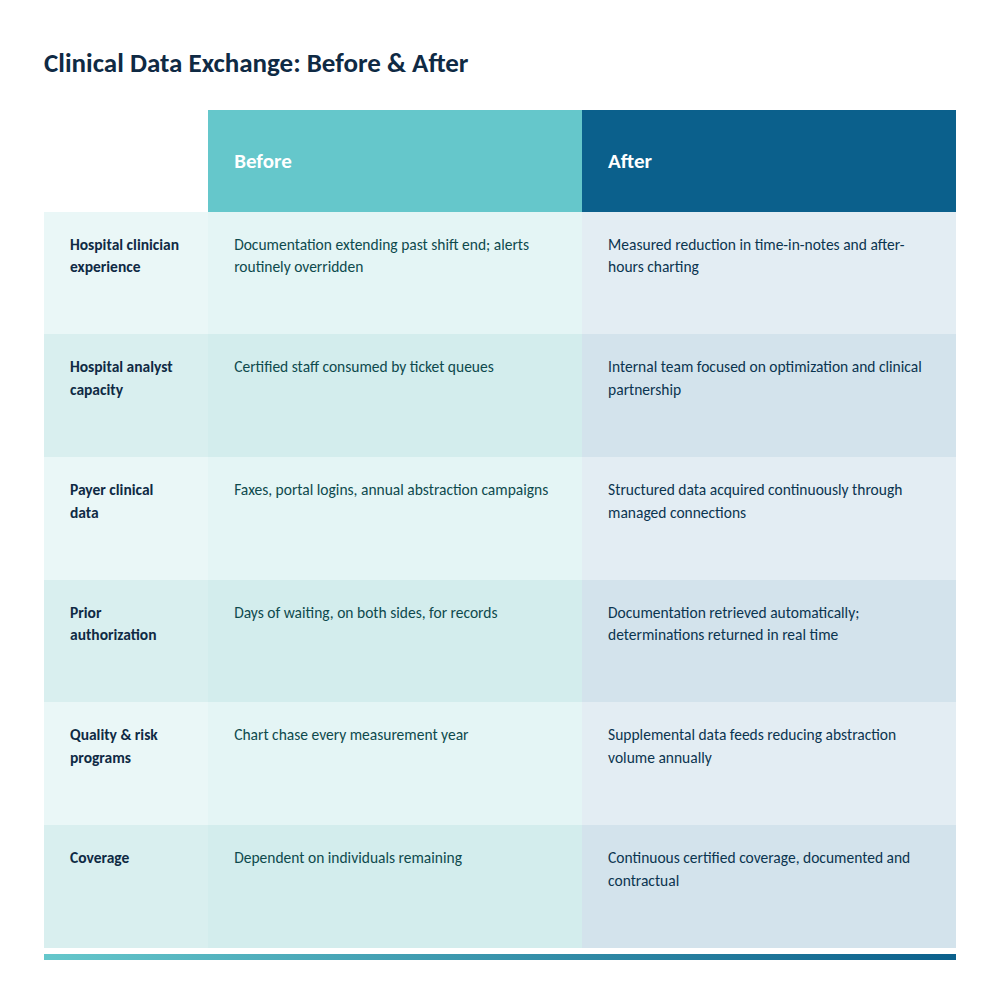
The pattern is consistent across organizations. Implementations are completed under schedule pressure, with optimization deferred to a phase that never receives funding. Documentation requirements accumulate faster than workflow is redesigned to absorb them. Alerts are added and rarely retired. Certified analysts spend their days closing tickets rather than improving the system.
Our orientation is value realization, not installation. The platform is in place; our work is making it serve the people who use it.
Elevance Systems Supports Your EHR Lifecycle
-
Program and project management, build and configuration, workflow design conducted with clinical and operational owners, testing and validation, data conversion and historical migration, training development and delivery, and command center support through go-live and stabilization.
Affiliation and acquisition work receives particular attention. Bringing a newly acquired hospital or physician group onto the enterprise instance means reconciling workflows, master files, and clinical culture — not simply extending a license.
-
Reducing documentation burden. Note template redesign, smart tool development, ambient documentation enablement, and elimination of duplicative requirements that accumulated without anyone deciding they should exist. Measured in time-in-notes and after-hours charting, not tickets closed.
Improving order and decision support design. Order set consolidation, clinical content governance, alert firing analysis and rationalization, and decision support tuned against actual override rates rather than vendor defaults.
Streamlining revenue cycle workflow. Registration and scheduling redesign, charge capture and coding workflow, denial reduction at the source, and financial clearance and authorization workflow improvement.
Raising adoption and proficiency. Personalization and efficiency coaching, physician and nurse efficiency programs, provider-level usage analysis, and targeted intervention for the clinicians struggling most.
Restoring clinical content governance. Ownership, review cadence, and change control for order sets, templates, alerts, and protocols — so content does not drift back toward the state you just corrected.
-
Tiered support under defined service levels: Level 1 through Level 3 with documented escalation, 24/7 coverage where downtime affects care, break/fix and configuration management, backlog reduction, and on-call rotation that does not exhaust your internal analysts.
Certified coverage is available by application, by module, or across the enterprise — scaled to demand rather than carried permanently. When a key analyst departs, or a module is left without qualified support, we cover the gap and document what we learn so the knowledge stays with you.
-
Version and quarterly release planning, impact analysis, regression and integration testing, environment management, change control aligned to your clinical governance structure, end-user readiness, and cutover planning built around surgical schedules and census rather than administrative convenience. We remain engaged through post-release stabilization, when issues surface and internal teams are most often left alone.
-
Business continuity access design and testing, downtime procedure development with clinical leadership, staff readiness exercises, recovery sequencing by clinical service — emergency department, operating room, and pharmacy first — and post-downtime data reconciliation. Coordinated with our infrastructure and security practices so technical recovery and clinical continuity operate under one command structure.
-
Current-state assessment and readiness evaluation, data conversion and historical record strategy, legacy archival and decommissioning, dual-maintenance management during transition, and post-migration optimization. For organizations consolidating instances after merger, we address the harder problem underneath: reconciling clinical content and workflow standards across organizations that each believe their approach is correct.
For Health Plans & Payers
Clinical Data You Can Actually Acquire, Without Chasing the Chart
Health plans are being asked to operate as clinical organizations — managing utilization, closing care gaps, documenting risk, and coordinating care — while sourcing clinical evidence through processes that have barely changed in twenty years. Medical records arrive by fax. Staff log into provider portals one at a time. HEDIS season becomes an annual abstraction campaign. Prior authorization decisions wait on documentation that exists in a system no one can query.
Building the capability that replaces processes.

Clinical Data Acquisition & Connectivity
Getting clinical data at scale, structured, and repeatably.
We establish and manage the connections through which clinical data reaches your organization: direct EHR integration with your highest-volume provider partners, HIE and TEFCA participation, FHIR-based bulk data and patient access APIs, CCDA and clinical document ingestion, and payer-to-payer data exchange as CMS requires.
Where data still arrives unstructured, we run the pipeline that makes it usable—document classification, extraction, structuring, and quality validation—while reducing dependence on manual abstraction year over year.

Utilization & Prior Authorization Enablement
Faster determinations, with documentation that arrives automatically.
Prior authorization is where provider and payer clinical data problems meet most directly, and where both sides pay for the gap. We implement electronic prior authorization aligned to CMS requirements, integrate clinical documentation retrieval into the intake process so reviewers don't request records that could have been fetched automatically, prioritize review queues by urgency and complexity, and connect determinations back to submitting providers in real time.
Because we support provider EHR environments as well, we can build this exchange from both ends — which is the difference between a payer-side portal and an integration providers will actually use.
Clinical Data for Quality, Risk & Care Management
Making acquired data serve the programs that depend on it.
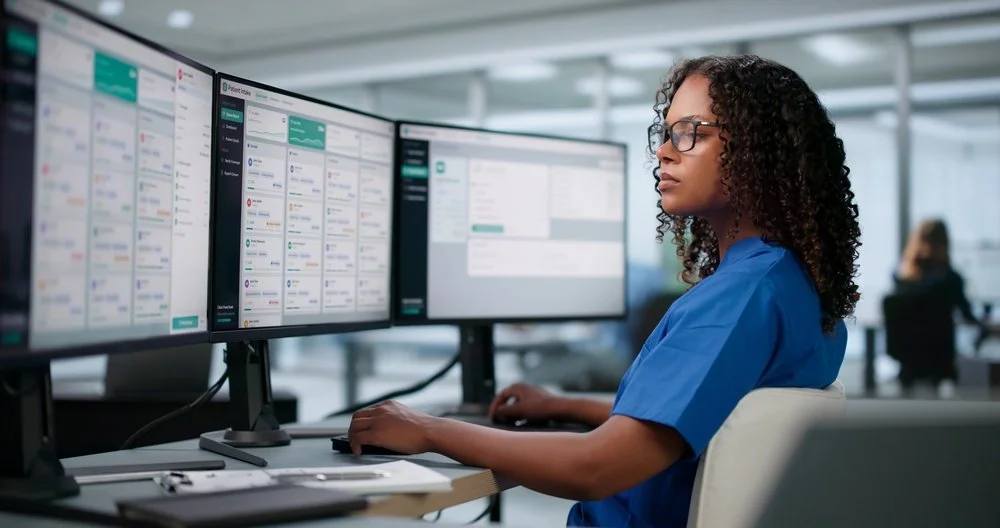
We integrate clinical data into the systems and processes where it produces value: HEDIS and Stars measure capture with supplemental data feeds that reduce chart abstraction volume; risk adjustment documentation with audit-defensible traceability; care management platform enablement so care managers see clinical events rather than only claims history, and admission-discharge-transfer feeds that allow transitional care outreach within the window that matters.

Care Management & Clinical Platform Services
Support for the clinical systems that health plans own.
We integrate clinical data into the systems and processes where it produces value: HEDIS and Stars measure capture with supplemental data feeds that reduce chart abstraction volume; risk adjustment documentation with audit-defensible traceability; care management platform enablement so care managers see clinical events rather than only claims history; and admission-discharge-transfer feeds that allow transitional care outreach within the window that matters.

Interoperability Compliance
Meeting regulatory requirements as a capability, not as a checkbox.
CMS Interoperability and Patient Access, Prior Authorization, and Provider Directory API requirements are frequently implemented minimally and separately, producing compliance without benefit. We build them on shared infrastructure, so the same investment satisfies the regulation and improves operations — patient access APIs, provider directory APIs, payer-to-payer exchange, and prior authorization APIs delivered on a governed FHIR foundation.

Integration & Interoperability
Interface development and management across HL7v2, FHIR, and X12; interface engine design, migration, and management, including Rhapsody, Mirth, and Cloverleaf; device and monitoring integration for providers; payer connectivity for eligibility, authorization, and claims status; HIE and TEFCA participation; API enablement and FHIR app integration; and message-level monitoring with automated replay, so that a silent interface failure is detected in minutes rather than at the next reconciliation.
Shared Capabilities
Reporting & Analytics
-
Operational dashboards for throughput, capacity, and length of stay; quality and regulatory measure reporting; provider efficiency and documentation analytics; revenue cycle and denial analytics; registry and research extracts. Where native tooling exists — Cogito and Caboodle, HealtheIntent — we work within it rather than around it.
-
Clinical and claims data unified for utilization, cost-of-care, and network analytics; quality measure performance with gap identification; risk adjustment completeness reporting; and care management outcome measurement.
What Changes
The Case for a Managed Model
Certified EHR analysts and healthcare interoperability engineers are among the most actively recruited professionals in the industry. Building and retaining that depth — across every module a health system runs, or every integration a health plan needs — is not a realistic expectation, and carrying it permanently is rarely the best use of budget or people.
Partnering with Elevance Solutions provides expertise available when needed rather than carried year-round, continuity that does not depend on any individual remaining, predictable operating cost in place of contractor spend and open requisitions, and capacity returned to your internal team for the work only they can do. Performance is measured, reported, and contractually committed.